Best AI Tools for Plumbers, Electricians, and Home Service Pros
AI for plumbers and electricians is solving a problem most shop owners know exists but have never had a clean way to fix.
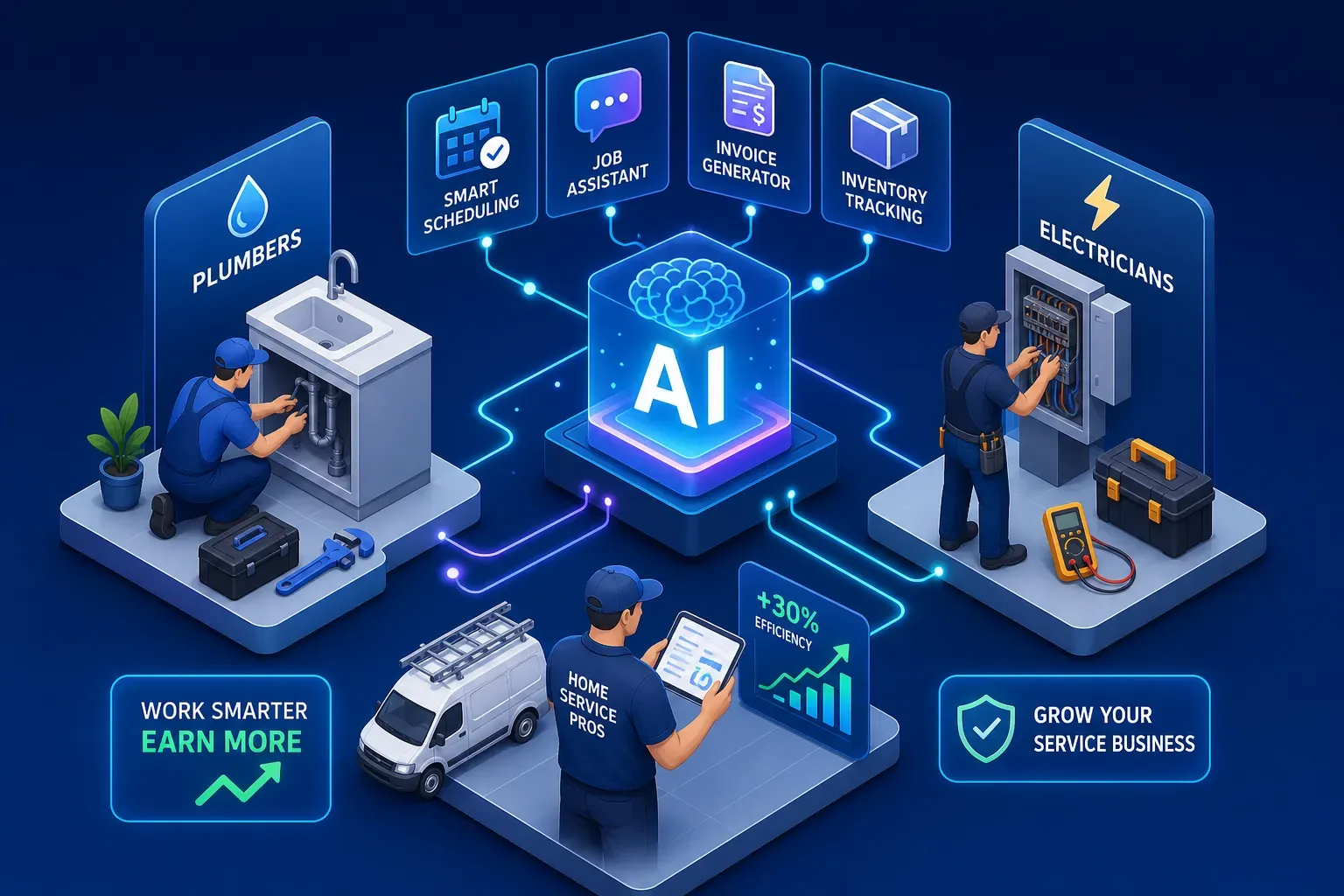
AI for plumbers and electricians is solving a problem most shop owners know exists but have never had a clean way to fix. Many plumbing and electrical shops still run their front office the same way they did ten or fifteen years ago. Sticky notes. A personal cell phone. Whoever picks up first. The problem is not that owners lack ambition. The problem is that they are buried in the actual work, and the office runs on inertia because nobody has time to fix it.
That is exactly where AI for trades businesses is delivering real, measurable results right now. Not in the truck. Not on the job. In the unglamorous spaces where margin quietly disappears: unanswered calls and invoices nobody is chasing, all running off a schedule that exists mostly in the owner's head. Platforms like Maximus were built and tested inside real home services companies before they were ever packaged and sold. That distinction matters more than it sounds. By the end of this article, you will know which tools solve which problems, how to evaluate an ROI claim honestly, and how to run a low-risk pilot that lets the numbers make the decision for you.
Where Trades Businesses Actually Lose Money
Most plumbers and electricians assume the leaks are in labor, parts, or pricing. They are not wrong to look there. But the quieter drain is in the operational gaps that compound week after week without ever showing up on a job report.
The Call You Missed at 7pm Booked Your Competitor
Research from field service industry analysts suggests that a significant share of inbound calls to small home service businesses go unanswered, some estimates put that figure above 60% for the smallest operators. For plumbing and electrical shops specifically, the miss rate is widely reported in the 20% to 40% range depending on staffing and call volume. Residential jobs are typically booked on urgency: the pipe is leaking now, the breaker keeps tripping, and the homeowner calls whoever answers. If your line goes to voicemail, they call the next number on the list. At an average job value of $150 to $500 per residential service call, a range consistent with industry pricing data, that math gets painful fast.
Aging Accounts Receivable as a Slow Revenue Leak
Many shops carry thousands of dollars in QuickBooks sitting at 30, 60, and 90 days past due. It goes uncollected not because owners are careless, but because the owner is on a job and the office, if there is one, is already stretched. This is not an occasional problem. It is a structural one. The invoices do not disappear. They just sit there and quietly become less collectible over time.
The Schedule Gap Problem
Manual scheduling creates inefficiencies that most owners never measure. Overlapping jobs, under-booked days, and technicians driving across town unnecessarily add up to real labor cost. Fixing this does not require a dispatcher. It requires a system that sees the whole board at once and fills gaps based on availability, location, and urgency, including predictive flags for equipment that has a service history suggesting it is likely to fail soon, which is where predictive maintenance logic earns its place in an AI-assisted dispatch workflow.
AI for Plumbers and Electricians: The Three Workflows That Actually Pay Off
Field service AI is not about replacing skilled tradespeople. It is about replacing the administrative work that no skilled tradesperson should be doing anyway. Here is where the tools have proven themselves, and what each one delivers in practice.
24/7 Call Answering and After-Hours Booking for Plumbers and Electricians
AI voice agents from platforms like Avoca, Sameday, and Maximus answer calls, qualify the job type, capture customer information, and book appointments directly into the field service management system without a human in the loop. The important distinction is between a basic call-answering bot and a trained AI agent that knows the shop's pricing zones, service area, and technician availability. The first captures a name and a message. The second closes a booking. For after-hours calls, which represent a substantial share of emergency plumbing and electrical revenue, that difference is the entire value proposition.
Invoice Follow-Up and AR Chasing on Autopilot
AI platforms can flag invoices past 30 and 60 days and trigger follow-up sequences without the owner manually tracking anything. Maximus demonstrated this in a published vendor case study with Temperature Pros Orlando, collecting $12,400 in aging accounts receivable within the first 90 days by connecting directly to QuickBooks and running systematic follow-up. That result reflects one shop's deployment; plumbing and electrical businesses with similar operational profiles may see results in the same category, though outcomes will vary by shop size, customer base, and how fully the tool is configured. The money was already owed. The AI just went and got it.
Scheduling and Dispatch Optimization
AI scheduling tools reduce drive time, match job urgency to technician availability, and fill schedule gaps automatically. Platforms that integrate with Jobber, Housecall Pro, and ServiceTitan can do this without a dedicated dispatcher. Field service benchmarks, including vendor-adjacent studies and operational analyses, consistently report 20% to 35% reductions in total drive time and 15% to 20% more jobs completed per technician after AI-assisted routing is deployed. Across a full month of routing, those numbers show up directly in labor cost recovered. Note that many of these benchmarks originate from vendor-sponsored reports; independent third-party studies covering small trades shops specifically remain limited.
How Maximus Was Built Inside a Real Trades Company
Many AI platforms are built by software teams with no field operations background. Maximus was built by people who have run home services businesses and dispatched techs to late-night emergency calls. That is not a marketing line. It is the reason the platform works differently than generic software bolted onto home services as an afterthought.
Built and Tested on Real Revenue Before It Was Sold to Anyone
Maximus was not designed in a software lab and then taken to market. According to vendor-published case material, it was proven inside Temperature Pros Orlando, a real HVAC shop, where it recovered over $31,000 from a single dormant customer reactivation campaign and handled daily operations including call answering, invoice follow-up, and morning briefings. That proof of concept, built on actual company data and real customer interactions, is why it translates directly to plumbing and electrical shops running comparable operations. The problems repeat across shops. The systems that solve them repeat too.
What Plumbing and Electrical Owners Are Replicating
Maximus bundles several capabilities that generic field service AI platforms do not combine in a single product. The platform answers every call in the shop's voice, around the clock, trained on specific pricing zones and service areas. It chases aging AR automatically. It runs dormant customer reactivation campaigns by pulling directly from QuickBooks history. Every morning at 7am, the owner gets a briefing covering overnight activity, outstanding items, and what was handled automatically. Every month, there is a one-on-one working session with the founder, operator to operator. The founding cohort is focused on shops in the $1M to $5M revenue range, according to Maximus's published enrollment criteria. That segment is where front-office inefficiency tends to be most expensive relative to overhead, and where purpose-built AI for plumbers and electricians has the clearest ROI case.
Evaluating ROI: What the Numbers Actually Mean
Vendor marketing materials carry claims of 285% ROI and 400% first-year returns from various providers. Some of those numbers come from real deployments. Many reflect best-case scenarios, not averages. Here is how to think about this honestly.
Published figures that show up in documented case studies include a 27x ROI on a $149/month call-capture tool, combined cost savings and revenue increases of $19,000 to $26,000 per month in plumbing shop deployments, and payback periods of 8 to 14 months for mid-size shops, all drawn from vendor case studies rather than independent audits. A Forrester Total Economic Impact study, commissioned by a field service scheduling vendor, found 346% ROI over three years with payback in under six months. That is a commissioned study, not neutral benchmark research, and results from a well-run enterprise deployment may not translate directly to a $2M plumbing shop. Take the headline numbers as directional, not definitive.
The more useful exercise is to build your own back-of-napkin model before buying anything. Take the number of calls you miss each month and multiply by your average job value. Add the dollar amount sitting in aging AR past 30 days. Compare that total to the monthly cost of an AI platform. If the math does not work on paper, the tool is probably wrong for your shop size. The numbers either justify the investment or they do not, and that calculation takes about ten minutes.
The Limits AI Cannot Cross in Licensed Trade Work
This is where most AI content in the trades space goes quiet. It should not. Being direct about what AI cannot do is more useful than pretending the limitations do not exist.
AI troubleshooting and diagnostic tools can help a licensed technician triage a problem. They can pull service history, suggest likely failure points, and surface relevant documentation faster than a manual search. What they cannot do is physically inspect a hidden pipe, verify that an electrical panel is code-compliant, or take liability for a recommendation that causes a flood or a fire. Local codes, inspection requirements, and licensing rules do not bend for AI output. The licensed professional's judgment and physical inspection remain the legal and ethical standard.
If an AI recommendation contributes to property damage or a code violation, liability typically rests with the contracting professional, though outcomes vary by contract terms, jurisdiction, and the specific facts of the situation. That is not a reason to avoid AI in your business. It is a reason to use it in the right places: front office and scheduling automation, invoice follow-up, and customer outreach. Not as a substitute for a licensed technician's assessment on a job site. The tools producing real returns for plumbing and electrical shops are the ones solving operational problems, not clinical ones.
How to Run a 30-Day Pilot Without Betting the Business on It
The shops that have gotten the most out of AI did not overhaul their operations at once. They solved one expensive problem, measured the result, and expanded from there. That framework keeps the risk low enough that you are making a decision based on evidence rather than gut.
Pick the one workflow that costs you the most right now. If unanswered calls are the problem, start with AI call answering. If aging AR is the problem, start with invoice automation. Do not start with everything at once. A tool that does one thing well beats a platform you half-deploy across six workflows and never fully measure.
Track two or three numbers during the pilot: calls answered versus calls missed before and after, AR balance at 30 and 60 days, and revenue booked through automated channels. Those numbers tell the story. At the end of 30 days, you are not making a philosophical decision about AI. You are reading the results and deciding whether to keep going.
The Bottom Line on AI for Plumbers and Electricians
AI for plumbers and electricians is not about replacing the trade. It is about replacing the manual administrative work that trades owners never planned to do themselves but ended up owning by default. Every owner who is personally answering after-hours calls, manually chasing invoices, and holding the schedule in their head is doing work that a well-configured AI system can handle more consistently, and at a lower ongoing cost, than adding another body to the payroll.
The shops winning with AI right now started small. One workflow. One measurement. Thirty days. Platforms like Maximus, built inside a real home services company and purpose-built for the $1M to $5M shop, make that starting point lower-risk than it has ever been. The missed calls are costing you money today. The aging AR is sitting in your system right now. Pick one problem, run the pilot, and let the numbers make the call.