Customer Reactivation Strategies Every Home Services Owner Should Know
Right now, sitting in your QuickBooks history, there are hundreds of customers who hired you, paid you, and then went quiet. They didn't leave a bad review.
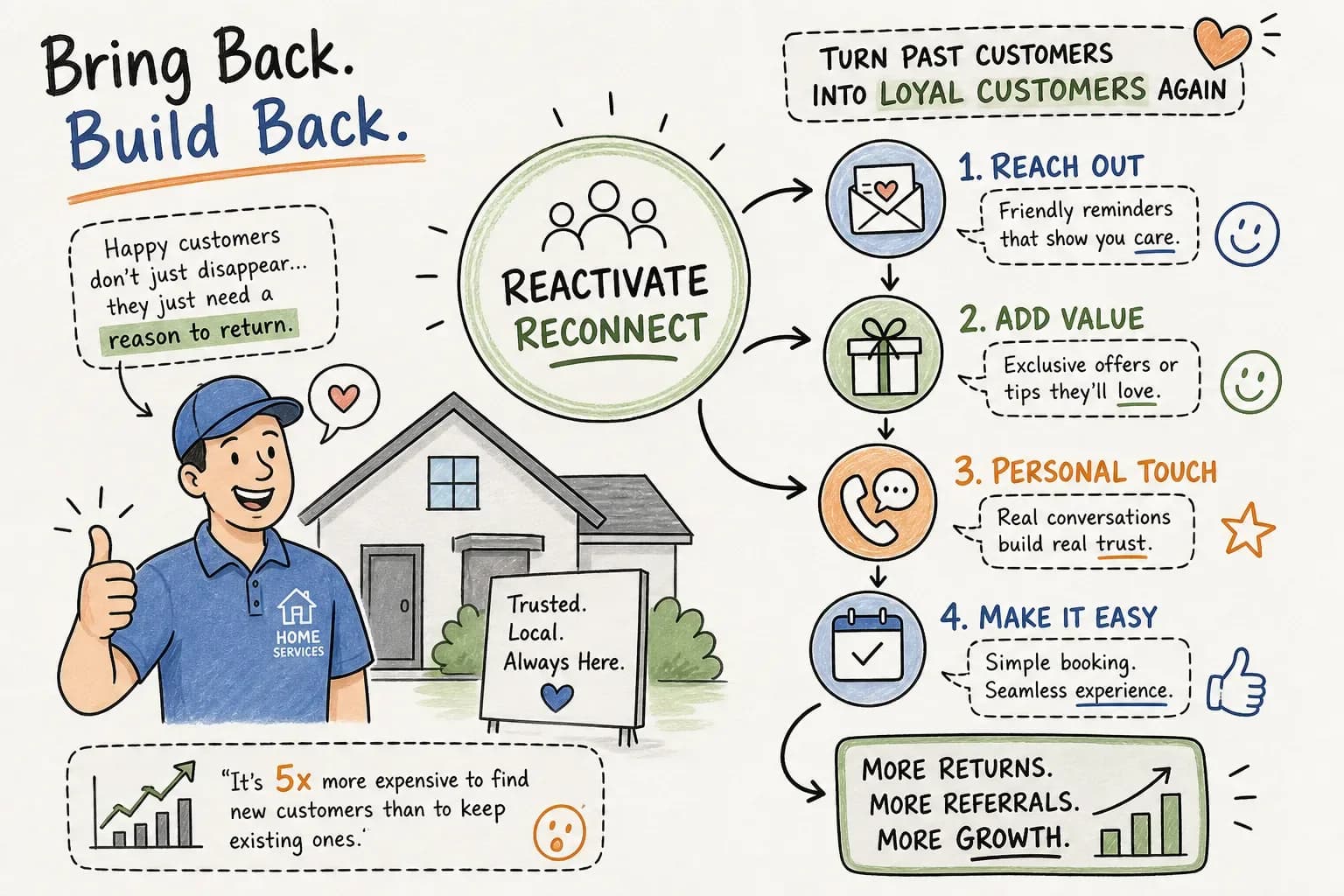
Right now, sitting in your QuickBooks history, there are hundreds of customers who hired you, paid you, and then went quiet. They didn't leave a bad review. They didn't call a competitor and complain. They just stopped calling. And every week you don't reach out to them, you're spending marketing dollars trying to replace people you already earned, a missed opportunity that the right customer reactivation strategies can fix.
A significant share of any home services business's customer list sits inactive at any given time. That's not a small problem. That's your most overlooked revenue source. Temperature Pros Orlando, the HVAC company where Maximus was built and tested, recovered over $31,000 from a single reactivation campaign by doing nothing more than working the existing list intelligently. No new ads. No new leads. Just a system that found dormant customers and reached back out with the right message at the right time.
This article gives you the full customer reactivation playbook: how to define and segment dormant customers, what to say and when to say it, which channels to use, and what results to actually expect. No theory. Just a repeatable process you can run on your own list starting this week.
Customer reactivation strategies: how to define and segment dormant customers
The word "dormant" means something specific in home services, and it's not the same as what ecommerce or SaaS businesses use. A software company marks a user dormant after 30 days of no login. A clothing retailer might use 90 days. Neither of those makes sense for a business where customers only need you once or twice a year.
For residential HVAC, the right benchmark is 12 to 14 months since last service. That represents one full missed maintenance cycle. Someone who skipped their annual tune-up isn't a churned customer at 90 days; they're just between appointments. Flag them too early and you'll annoy people who were planning to call anyway. Wait too long and they've already found someone else. For plumbing and other on-demand services, use two missed expected service cycles as your trigger, which typically lands between 60 and 180 days depending on your service cadence.
Once you have your dormancy threshold defined, segment your list into three tiers. Tier 1 is 6 to 12 months inactive: the warmest group, easiest to reactivate, and where you should focus first. Tier 2 is 12 to 18 months: they're cooling off and need a stronger reason to act. Tier 3 is 18 months or longer: lower reactivation rate, but still worth a single honest attempt.
Each tier gets different messaging, different urgency, and different offers. Sending the same generic message to all three tiers is one of the most common reasons reactivation attempts fall short, research on personalization and segmentation consistently shows that tailored outreach outperforms blanket sends by a wide margin.
The practical barrier most owners hit here is data. They know dormant customers exist, but pulling a segmented list from QuickBooks requires running the Sales by Customer Summary report, exporting to a spreadsheet, filtering by last invoice date, cleaning duplicates, and building segments manually. That's a weekend project most owners never get to. Maximus pulls dormant contacts directly from your QuickBooks history, flags them by last service date, and segments them automatically so the campaign can start without anyone building a spreadsheet from scratch.
The reactivation sequence: timing and number of touchpoints
One message doesn't work. Owners send one email, get a modest open rate and a handful of replies, then declare the campaign a failure and move on. The problem isn't the campaign; it's the expectation that a single touchpoint is enough. Lapsed customers aren't hostile. They're just busy and disengaged. Multiple touchpoints, commonly two to five across channels, rebuild the familiarity that got them to book in the first place.
A practical win-back sequence for home services looks like this. Touch 1 goes out on Day 1: an email that reminds them of their last service without making a hard sell. Touch 2 follows on Day 5 to 7: an SMS or second email that adds mild urgency, typically tied to seasonal relevance or scheduling availability. Touch 3 lands on Day 10 to 14: a final message with a clear offer and a permission-based close. These day ranges are a solid starting point; adjust based on your business cadence and list quality as you gather data.
The third message earns its importance partly through that permission-based close. Framing the conversation with a natural endpoint, "if we don't hear from you, we'll take you off this list", paradoxically increases response rate because it creates a decision point instead of an open-ended ask.
The biggest failure point in reactivation isn't the strategy. It's execution. Owners build the sequence, send Touch 1, and then a busy week swallows Touch 2 and Touch 3 never happens. Maximus runs the full sequence automatically once segments are identified, handles the timing, switches channels between touchpoints, and keeps the campaign running without the owner needing to push it forward each week.
What to say to a customer who hasn't called in over a year
Subject lines that get opens
Subject lines are where most reactivation campaigns win or lose before a single word of copy is read. The patterns that outperform are permission-based and specific. Lines like "Should we still be in touch?" and "It's been a while since your HVAC service, [Name]" consistently beat "We miss you!" because they're grounded in the customer's actual history rather than generic sentiment. Curiosity-driven lines like "What's changed since your last service" work when you have something concrete to back them up.
Email body structure
For the body copy, use a four-part structure. First, acknowledge the time gap simply and without drama. Second, reference their specific past service so the message feels personal, not mass-blasted. Third, give them a concrete reason to act now, whether that's seasonal timing, a new service offering, or a modest incentive. Fourth, close with one clear call to action. Not two options. One.
Here's a short example you can adapt for HVAC:
"Hi [Name], it's been about a year since we last serviced your system. With [season] coming, now's a good time to make sure everything is running right before you need it most. We're offering priority scheduling this month for past customers. Reply to this message or call us at [number] to book."
That message acknowledges the gap, ties to their history, provides seasonal relevance, and closes with one action. No discount required, no drama. Just a direct message from a business that paid attention.
Customer reactivation strategies, channels and offers that move the needle
Email has the best ROI per send because the cost per contact is essentially zero at scale. SMS has the highest conversion rate because open rates are dramatically higher and responses come faster. Together, they outperform either channel alone by a wide margin. The sequence to follow: start with email for Touch 1, introduce SMS at Touch 2 for contacts who have opted in, and use a final email with a permission-based close for Touch 3. For Tier 3 contacts who have been inactive for 18 months or more, direct mail can work as a complement, especially for high-value service areas where the cost per contact is justified by the potential job value.
On offers, the instinct most owners have is to lead with a discount. That's usually the wrong move. Before you cut price, consider these alternatives in order:
- Priority scheduling: costs you nothing, but carries high perceived value for customers who've dealt with long wait times elsewhere
- Free inspection or safety check bundled with a booked service: gets the technician in the door without a price cut on the primary job
- Credit toward next service: protects current-job margin while creating a built-in reason for a return visit
- 15 to 25% discount, time-limited and segmented: appropriate for Tier 2 and Tier 3 contacts, but only when it's specific, expiration-dated, and tracked, and sized to your actual margins
Blanket discounts sent to your whole list train customers to wait for deals before booking. Adding value beats cutting price in most cases. The exception is Tier 3 contacts who haven't responded to anything else; a moderate, time-limited offer gives them a legitimate reason to act without permanently repositioning your pricing in their mind.
What good performance actually looks like
Set your expectations correctly before you run the first campaign. A well-segmented dormant customer reactivation effort for home services should produce an open rate between 20 and 35 percent. A reactivation rate of 10 to 25 percent of the dormant segment converting to a booked job is the achievable range for multi-channel sequences. Email-only campaigns land closer to 2 to 6 percent. The combination of email and SMS is where you hit the higher end of that range.
The metric that matters most isn't open rate. It's revenue per reactivated customer. To put that in concrete terms: if you have 200 dormant Tier 1 customers and reactivate 10 percent of them, that's 20 booked jobs the business would never have seen otherwise. Run the math using your own average ticket value and you'll see quickly why this list deserves attention. That calculation changes how seriously most owners take the campaign.
Unsubscribes are not a failure metric. Some list attrition is expected and actually healthy. When a lapsed customer opts out, they're cleaning your list for you, improving deliverability and helping you focus budget on contacts who actually want to hear from you. Treat a clean unsubscribe rate as confirmation your targeting is working, not as a sign the campaign went wrong.
Your first campaign is also a data-collection exercise. You'll learn which tier responds fastest, which subject line pattern outperforms, and which offer actually converts. The second campaign, run with that data, will perform better. Starting with no baseline is still better than leaving those contacts untouched. Even a 10% reactivation rate on a list you've been ignoring is pure recovered revenue.
Stop leaving past customers on the table
Dormant customers are the most overlooked revenue source in home services. They already know you. They already trusted you once. The cost to reactivate them is a fraction of what it costs to acquire someone new. The barrier has never been strategy; it's been execution. Owners know they should run these campaigns. They just don't have a system that makes it happen without their direct involvement every step of the way.
The actions are straightforward: define your dormancy threshold based on your service cycle, segment your list into three tiers, build a three-touch sequence, lead with personalized messaging tied to their actual service history, pair email with SMS, and lead with value before you ever lead with a discount. These aren't complicated ideas. They just require a system that actually runs them.
If you have contacts in your QuickBooks who haven't booked in 12 months, that's where the next campaign starts. Not a new ad. Not a new market. The list you already have. Maximus was built to make that campaign run without a spreadsheet or manual follow-up, and without the owner needing to track every step. Start applying these customer reactivation strategies to recover revenue from your existing list this month. If you want to see what that looks like for your shop, that conversation starts at askmaximus.ai.