HVAC Business Plan Template: A Step-by-Step Guide
Many HVAC owner-operators have built real businesses without ever writing a business plan a lender or buyer would take seriously.
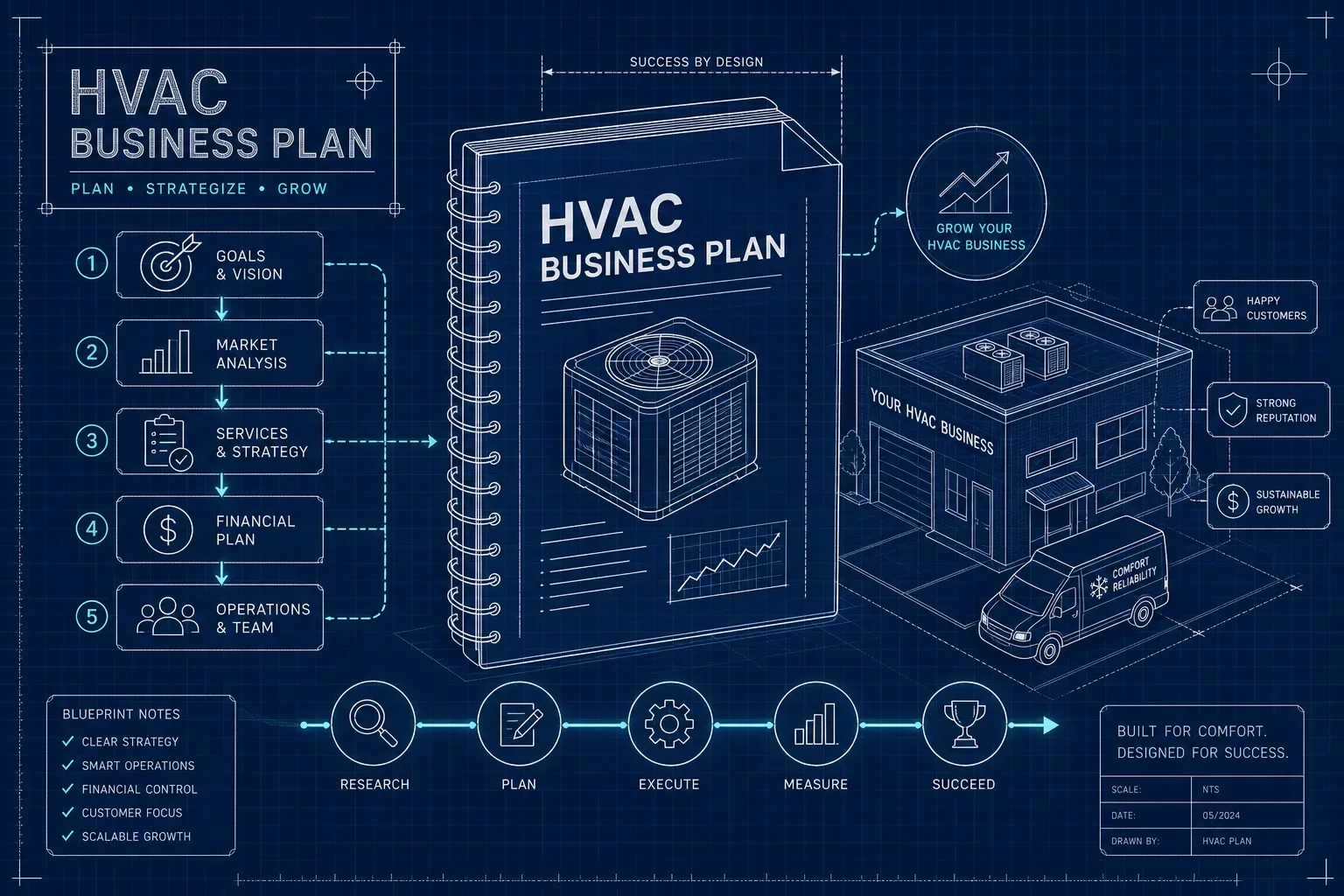
Many HVAC owner-operators have built real businesses without ever writing a business plan a lender or buyer would take seriously. A solid HVAC business plan template changes that, but only if you treat it as a working document rather than a one-time funding pitch. This guide walks through every major section you need, written specifically for the owner-operator who wants something that works for a loan application, a banking relationship, or an eventual sale. No generic startup advice. Just the sections, what belongs in each one, and the numbers that make it credible.
The reason most plans fail isn't that the business is weak. It's that the plan doesn't speak the language of the person reading it. A lender reads your plan to answer one question: can this business repay the debt? A buyer reads it to answer a different one: does this business run without the owner? A well-built heating and cooling business plan answers both questions at once, and that's exactly what this guide helps you do.
What Makes a Heating and Cooling Business Plan Actually Fundable
Lenders and buyers are not reading your plan the same way. Lenders focus on cash flow, debt service coverage, and whether your startup capital requirements are realistic. The standard debt service coverage ratio lenders look for is around 1.25x, meaning your business needs to generate $1.25 in cash flow for every $1 in loan payments. Buyers and investors focus on operational independence: does the revenue depend on systems, or does it depend on you personally showing up every day?
The structural decision that separates a fundable plan from a forgettable one is treating the plan as a living document. An HVAC business plan template works best when it's updated regularly, month-by-month for Year 1 cash flow, then at least quarterly after that, so the numbers reflect reality rather than optimism from two years ago. Write it once to get a loan and file it away, and you've produced a liability, not an asset. The best HVAC company business plans are the ones the owner actually uses to run the business.
The Business Foundation Every HVAC Company Plan Needs First
Before any numbers appear, a credible HVAC company business plan establishes the basics clearly: who you are, what you do, where you do it, and who your customer is. These sections feel obvious but they're where most plans go vague. Vague descriptions undermine the financial projections that follow, because a reader can't evaluate numbers they don't understand in context.
The executive summary is written last but read first. Keep it to one or two pages. It should cover the business concept, revenue model, market opportunity, any funding request, and the owner's background and credentials. The company overview section goes deeper: legal structure, founding date, location, services offered, certifications, and anything that genuinely differentiates the business from the next HVAC shop in the same zip code.
Service area definition and target customer profile belong here too, and both require specifics. Define your service area with zip codes or radius distances, not just city names. Identify your primary customer segments: residential repair, residential install, commercial service, maintenance agreement holders. A plan built on recurring maintenance revenue reads very differently to a lender than one built on installation volume, because maintenance contracts create predictable cash flow and installations create lumpy revenue. Make that distinction clear, because it affects how the lender evaluates risk.
HVAC Business Plan Template: Pricing Structure and Financial Projections
Lenders focus heavily on the financial projections section, particularly cash flow and debt service coverage, and it's where most HVAC operators undersell themselves because the numbers aren't organized. Build your pricing structure around real cost of service, then translate that into a 3-year financial model.
Ticket Sizes and Gross Margins by Service Type
Residential installation tickets typically run $5,500 to $14,000. Service and repair calls average $300 to $800, with emergency calls pushing $800 to $1,200. Maintenance visits benchmark at $200 to $400 per visit. Gross margins differ sharply by type: repair and maintenance typically run 45 to 65 percent, while installation sits lower at 18 to 35 percent depending on job mix.
3-Year Financial Model
For the financial model, you need three documents: a 3-year profit and loss statement, a cash flow statement, and a break-even analysis. A realistic single-tech HVAC operation can project Year 1 total revenue around $425,000, scaling to roughly $640,000 in Year 2 and $905,000 by Year 3 as you add staff. Gross margin should hold in the 48 to 50 percent range if the service mix is right. Net profit in Year 1 is often negative or thin as the business absorbs startup costs; lenders understand this as long as the trajectory is clear and the assumptions are defensible.
Startup Costs and Break-Even Analysis
Startup costs for a standard owner-operator launch in 2026 run $40,000 to $80,000, covering a service van, tools, insurance, licensing, software, initial inventory, and working capital. Add a second truck and staff, and that number climbs to $150,000 or more. The break-even formula is straightforward: divide your total fixed monthly costs by your contribution margin per job. Industry guidance commonly recommends including roughly 90 days of operating cash in your startup capital assumptions, and HVAC seasonal patterns make that cash flow timing critical. A plan that shows strong summer revenue without accounting for the February slowdown will get flagged immediately.
HVAC Marketing Plan: How You'll Actually Bring in Customers
A marketing section that lacks channel-specific budget allocations, expected lead volumes, and cost-per-acquisition figures will likely be inadequate for underwriting or buyer diligence. Describing your marketing as "word of mouth and Google" won't satisfy a lender or a buyer. The marketing section of your HVAC startup plan needs those channel-level details connected directly to your revenue projections. Without that, the financial model has no foundation.
Three channels consistently deliver for HVAC businesses. Google Business Profile and local SEO produce the lowest long-term cost per acquisition, typically $30 to $90 per lead after the first year once the listing has reviews and local authority. Google Local Services Ads (LSAs) are the best immediate paid option for high-intent leads, benchmarking around $51 per lead with strong closed return on ad spend based on current industry benchmarks. Referrals and maintenance plan reactivation remain the cheapest acquisition channel of all when they're systematized rather than left to chance.
The key step most operators skip is connecting customer acquisition cost (CAC) to the revenue forecast. If LSAs generate leads at $51 each, that figure belongs in both the marketing expense line and the revenue assumption. When those two numbers are consistent with each other, the plan becomes internally coherent. When they're disconnected, a careful lender will notice and question everything else in the document.
Staffing Model, Licensing, and Compliance Requirements
Lenders and buyers both examine whether the business has the legal foundation to operate and whether the staffing model makes sense at the projected revenue level. For a healthy HVAC operation, direct field labor should benchmark at 20 to 25 percent of revenue, with combined field and admin labor targeting 28 to 32 percent. Revenue per technician in a well-run residential service company typically runs $200,000 to $350,000 annually, which gives you a clear method for projecting when you need to hire.
One decision that matters for how the plan reads: treat owner compensation as an operating expense, not just a distribution. If the business only looks profitable because the owner isn't counting their own labor as a cost, the business isn't actually profitable. A lender or buyer will recalculate the numbers anyway. Build owner pay into the P&L from the start so the margins reflect reality.
The compliance section is non-negotiable. Every HVAC business plan should document the following:
- EPA Section 608 certification for any technician handling refrigerants, which is a federal requirement
- State HVAC or mechanical contractor license, which typically requires experience, an exam, and a background check
- General liability insurance, often required by the state licensing board and by commercial customers before site access
- Workers' compensation insurance once you have employees, required by most states
- Local business license from the city or county
Verify state-specific requirements through your state contractor board, your secretary of state's office for entity registration, and your state workers' compensation agency for insurance rules. Requirements differ significantly by state, and a plan that lists generic compliance items without confirming state-specific rules signals that the owner hasn't done the homework.
Operational Systems: The Section Buyers Evaluate Before Anything Else
When a private equity buyer or strategic acquirer evaluates an HVAC company, they are not just buying the revenue. They are buying the business's ability to produce that revenue after the current owner leaves. That means documented dispatch processes, pricing structures, call handling procedures, accounts receivable workflows, and customer follow-up systems. If those systems live in the owner's head, the business is worth a fraction of what it could be. PE buyers start their evaluation at EBITDA and recurring cash flow; they immediately discount both if operational independence isn't demonstrated.
An operational systems section in your plan should describe specifically how jobs are booked, dispatched, priced, invoiced, and followed up. It should cover how the business handles missed calls, aging receivables past 30 and 60 days, and maintenance agreement renewals. "I handle it" is a liability in a business plan. A documented, repeatable process is an asset, and the distinction between those two things can meaningfully change the multiple a buyer is willing to pay.
Owner-operators building toward a sale have a real advantage if they've set up the right infrastructure before that conversation starts. Platforms like Maximus, built specifically for home services owner-operators, handle call answering, job booking, accounts receivable follow-up, and customer reactivation automatically. They also create a documented, auditable record of how the business operates day to day.
For a buyer evaluating an HVAC acquisition, seeing that front and back office functions run on automated systems, rather than on a single person's availability, is direct evidence of operational maturity. Including that documentation in your HVAC business plan template turns the operations section from the weakest part of most HVAC plans into a genuine competitive differentiator.
A Business Plan That Actually Gets Used
A strong HVAC business plan template isn't a one-time exercise. It's the clearest picture you'll ever have of where your business is, where it's going, and what it's actually worth to someone else. Use the sections covered here: foundation, financials, marketing, staffing, compliance, and operations. Fill in real numbers from your own books alongside industry benchmarks. Then update it regularly, monthly for Year 1, quarterly after that.
You can use a free HVAC business plan template or HVAC business plan sample to structure your first draft, but the numbers and operational details have to be yours. A plan built on real data from your own operation is far more credible to a lender or buyer than any generic HVAC business plan PDF you download and fill in halfway.
The plan you hand a lender or a buyer shouldn't be the one you wrote three years ago to get a loan. It should be the one you've been living by. That's what turns an HVAC company business plan from a document into proof that you've built something real, something that works with or without you in it every day.